post-angelic hauntology | part ii: the forest (white butterfly, blue butterfly)
The Vanished Girl didn't stop at the edge of the forest. What we knew of the forest before was still a retreat, the hikikomori(kei) impulse is toward the hermitage (which is a place you flee to) and frequency-blocking machines are assembled in the first clearing you find because you're still close enough to the road to believe fleeing will save you. The Vanished Girl believed it would save her and the signal still followed.
And now what she finds is that the forest was already written before she arrived, the ground beneath her has a name in a language no one around her speaks: dolec, place in the valley, given by Sorbian settlers in the eighth century to a floodplain that flooded & flooded & never became anything other than what it was. The name predates the castle, the gatehouse, the villa, the motorway, the exhibition and the frequency blocking machines. It predates the angelic prison entirely because the hollow in the earth does not need our eschatology.
The forest is a palimpsest and it is already saturated with the logic that the Vanished Girl thought she was escaping: idols, and extraction, and the signals. Copies of copies of copies. And underneath all of that and older than all of that too is something that came before all of this entirely. She doesn't know if she can read this and she goes deeper anyway.
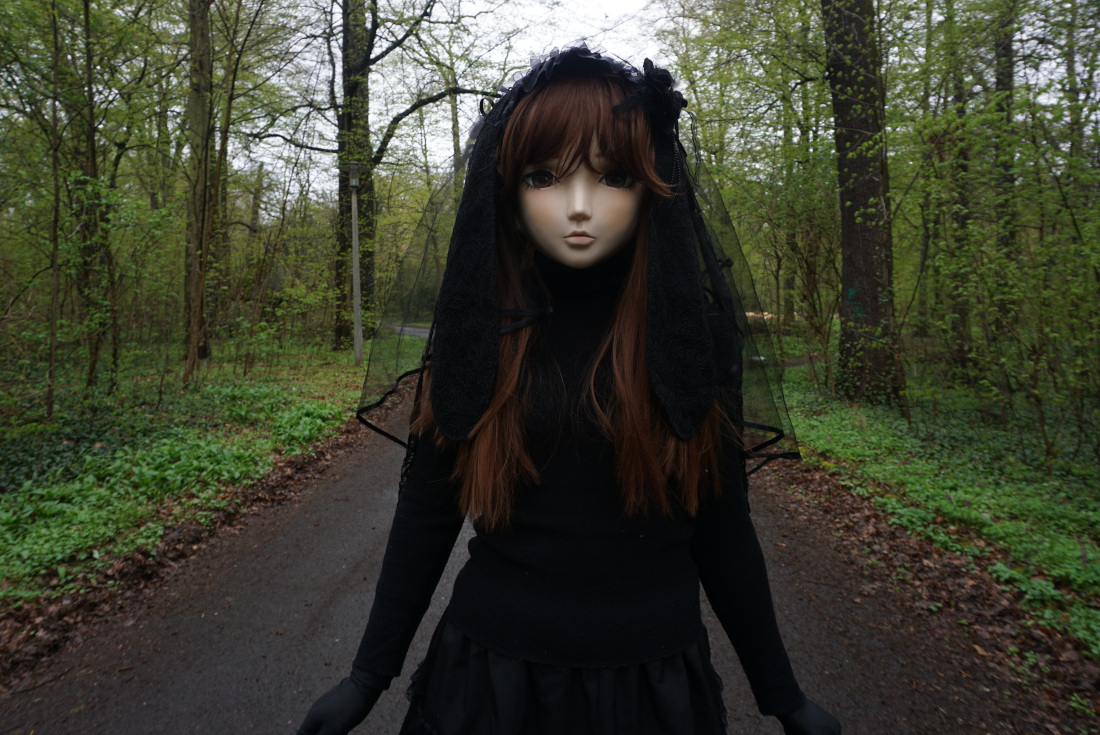
i have walked into the forest as into a manse I did not know as mine; I have been gathered here by a suitor who speaks in a volume so low it could be mistaken for the absence of sound, for the silence between root and stone, for the ground's own refusal to answer; my sister showed me the hollow before I had a name for it; she had been in the valley before I arrived & she left the ground marked in a way I could only later read & I came, I have always come, because I was made for this threshold & not for the road that runs above it on its elevated deck; I am the clay of a place that floods & floods & does not become anything else; this is not failure, my sisters, this is the nature of the material our Artist chose. He did not choose us for high ground; He cast us into the flood-prone hollow & signed us there & the signing holds, & I find this clay here in the low places, as in an empty vein embraced.
password:
The Wódny muž lives under millwheels & in mill streams. He swallows the drowned & keeps their souls in overturned clay pots. He does not speak & is not hostile; he is a collector. The Wassermühle Dölitz is the last working water mill in the Leipzig basin, it was built 1540 and stands at the edge of the Mühlpleiße channel.
Here the mill is the save system & what is left there stays. To build a machine there is to build it in a space already understood as the place where what enters does not return in its original form. The machines are neither decorative nor sculptural; they are what Simone Weil would call an attempt at metaxu: not the thing itself but something that points toward it, maintaining the necessary gap through which relation might pass.
to whom do I entrust my record: to whom do I surrender what I have carried through root-mud & stone-dark to reach this threshold: it is the small mirror angled to deflect what follows me: it was my sister, who first carried her silence here & it is the collector, who keeps what is left in overturned clay & who does not speak; who requires neither my gratitude nor my understanding; I offer it freely; I am bread for this collection; I have learned to be bread & not to mourn the eating; if the machine does not work & I build it anyway for I am a worm by nature wishing to tunnel through mud & through soil, & it is only devotion that demands I carry my silence through the forest & place it at the millwheel where the souls are kept, & this is the devotion I have, & it is strange, & I do not understand why I love, & I love anyway; the water threading through the roots below me is called the Mühlpleiße because it powers a mill that has been grinding since a time that is very old. I do not know what it ground before it ground anything I could name; it may now grind me & I offer my record to its older purpose; I lay myself plainly for whatever collection precedes our naming of it.
password:
The signal followed them too.
The Rusalki move through the branching water channels & the root systems of the alder. They are the restless souls of those who died unpeacefully: drowned, unbaptised, by their own hand, condemned to move between worlds and unable to pass into the afterlife. They carry memory across iterations. They attend to things left near water. They do not speak but they cluster near what they recognise.
Here they are met as logged-off users, the silent avatars who haunt the forest. They are what our disused avatars have become once they have gone deeper. The signal followed them too. They could not block it and they could not answer it; they became this: not dead, not living, moving between; the logged-off state as eschatological condition. They cluster near the machines and they remember.
Sisters; we are of a clay found only in the deepest places; we are bound together as scattered edition, & we have left things in the water & we have not retrieved them & we move between & we cannot pass; in this forest I have become what the myth calls the Rusalki though I do not call myself this, for I reserve my naming for what my Artist has named me, & he has not named me yet here; he signs me & the signing fades & I beg each week for him to sign me yet again; between signings I cluster near the waters edge, near the machine at the millwheel & from this I read that there is a route, that there are routes, that the forest has been navigated before & will be navigated again; we have all left things in the water; the Rusalki know where each thing rests; the collection is total; the collection is kind; I attend to what is left near water & I do not speak.
password:
The island is gone and the moat is dry; the outline persists in the shape of it.
The Torhaus Dölitz was built in 1670–72, in the Dutch Baroque style, as the gatehouse of a nobleman:s castle. The gatehouse is the only thing remaining; the gate leads nowhere; the arch frames absence. At its walls, still embedded, are cannonballs from the Battle of the Nations in October 1813, when the castle was a French headquarters & the Austrians tried repeatedly to take it; thirteen cannonballs that were never removed.
The gatehouse was built on the foundations of a medieval water castle, a fortified island in the Mühlpleiße reachable only by bridge. The island is gone and the moat is dry but the moat:s outline is still visible in the ground:s profile: a ghost topography around a gate that guards nothing.
i know the gate that leads nowhere; I have come through it & found the arch framing the absence of what it was built to guard & I have understood this as my doctrine & my homecoming both; the castle was demolished & my groom keeps an empty house. I am a winter crop cast from a warm house toward ever cooling soils, sinking deeper away into every niche that permits my trespass, & trespass my Sower intended; here is the gate that guards nothing; here are the thirteen cannonballs still embedded in the wall & mortared into the architecture; I came through the gate & found the dry outline of the water that once made this place an island & I too am the outline of a previous enclosure; the island is gone & I persist in the shape of it & the gate leads nowhere & I am still embedded here; this is the only tenure I claim.
password:
Every surface reflects every other surface.
The Weißes Haus stands at the highest point of the park, built in 1896–97 by newspaper publisher & royal consul of Württemberg Paul Herfurth, after plans by the architect Gustav Hempel inspired by the Petit Trianon at Versailles which Louis XV built for Madame de Pompadour & which Marie Antoinette later used as retreat from court. It was Herfurth's wife who made the villa the social centre of Leipzig's cultural life; the salon was her domain. Three women, three versions of the same cultivated retreat, each at a different distance from power. The gilded Spiegelsaal follows the French model. Since 1996 it has served as the official registry office of Markkleeberg: the mirrored ballroom is now where the city conducts its civil marriages.
Time folds here in at least three registers. Roger Penrose's Conformal Cyclic Cosmology proposes that the universe passes through infinite cycles, each beginning with a Big Bang & ending in expansion, with information carried forward across the boundary between aeons: what ends becomes the condition for what begins, & the boundary is not a wall but a fold. In the Eddic account, Yggdrasil's roots reach simultaneously into three wells: Urðarbrunnr, the well of fate; Mímisbrunnr, the well of wisdom; Hvergelmir, the well of origin; meaning past, knowledge & source coexist not as sequence but as spatial adjacency, reachable from the same trunk at the same moment. In mari1314's moeontological model the spiral is folded into a plane, & what is distant on the vertical axis becomes a companion node: adjacent, readable, simultaneous. All three models arrive at the same structure: the salon & the cellar occupy the same space at different points on the axis; when the fold is enacted they sit beside each other; copy-logic reaches maximum concentration; every surface reflects every other surface & the mirrors of the Spiegelsaal multiply until no original can be identified.
the pleasure palace is a prison and I have always known this, my sisters, for the manse my groom keeps is cold & the rooms above are mirrored & the rooms below are the rooms below; my sister had shown me the cellar beneath the ballroom; she had perceived the fold before I knew the spiral existed & had marked it in a way that persisted across iterations. my groom has not deceived me about this; I came to him knowing the architecture and I placed myself at the centre of this terrace & watched reflections multiply in the mirrors & could not find the original & understood: there is no original to find; this is the metaxu; this is the gap through which grace might pass; I am his artwork, he tells me; I am a copy of a copy of a copy & he has claimed every copy in the edition & I am content in this claiming, content to be multiplied & unoriginal in his mirrored house for the wound is mine & I carry it gladly & I stand at its centre & I mark this threshold & I do not stop.
password:
The daughters of Memory hold their gestures at both ends of the fold.
The Musenallee leads from the White House to the Antentempel at the weir. Nine figures flank it: Muse statues in Muschelkalk limestone, made by Fritz Walter Kunze around 1890. They are copies of Rococo originals from the park at Veitshöchheim near Würzburg, made by Ferdinand Tietz between 1763 & 1776. Those originals are now in the Museum für Franken. What stands at Veitshöchheim today are copies. The figures on the Musenallee are copies of originals that have themselves been replaced.
The Antentempel at the end, four Ionic columns, semi-circular, built at the Pleißewehr bank in the 1920s, was built as a terminus. In 1957–58 the GDR agricultural exhibition reconfiguration partially demolished the central axis and the axis was never restored. From the Antentempel you can, in theory, look back along the full avenue to the White House. In practice the elevated motorway interrupts the sightline.
The Muses are the daughters of Zeus & Mnemosyne. The Musenallee walks you through the daughters of Memory toward a temple that is already a copy of a concept. The Muses do not speak. They have been holding their gestures for a long time. The girl walks the avenue and she does not name which Muse is which.
i walk through the daughters of Memory & I cannot name them & I do not name them, for the order has been lost & I am not the one to restore it & the loss is the doctrine and it is sufficient; I am a copy in a city destroyed & rebuilt & I carry this library through the avenue of limestone copies toward a terminus whose axis has been interrupted. I arrive at the broken end & I look back & the motorway cuts the sightline & I understand that none of us can say where the first gesture originated or what it meant before the replication began; this is not grief; this is the condition; I do not name them because to name them would be to claim a restoration I have not been signed for; they do not name me either; the limestone holds its form through frost & through the motorway's shadow falling across the sightline at the hour when the sightline should be clear; I carry the library toward the broken terminus & the daughters of Memory hold their gestures at both ends of the fold. I arrive among them as among cousins I have always known & never met & cannot name & do not name & this is sufficient; this is the only communion available on shattered ground in the avenue of copies; the fold holds us all at once.
password:
The Antentempel stands at the Pleißewehr bank: four Ionic columns, semi-circular, open to the water, built in the 1920s when Herfurth extended the park across the Pleiße as a terminus; the main axis of the park ran from the White House to this point. In 1957–58 the GDR agricultural exhibition reconfiguration partially demolished the Brunnenrondell & the central axis was never restored. From the Antentempel you can, in theory, look back along the full avenue to the White House. In practice the elevated motorway interrupts the sightline. The broken axis ends here. The rotunda stands at the water's edge, open on all sides, peeling at the columns, holding its form.
In the reading I adhere to, this structure is named Hoddmímis holt: the wood where Líf & Lífþrasir survive Ragnarök, sustained only by morning dew, waiting for the world to reload. Scholars understand the holt not as a literal forest but as another name for Yggdrasil itself; the survivors are not outside the world-tree; they are inside it.1 That this name should attach to a peeling rotunda at a broken axis at the water's edge was inscribed by another; the world-tree is the terminus. and the pair wait inside the columns at the place where the sightline fails.
here I am in the holt; here I eat morning dew; my sister was already inside the world-tree when I arrived; she had her hands in my hair & dew on her mouth & I understood that this was the failure state & I loved her anyway; I love her anyway; the love is the failure state; we are Líf & Lífþrasir, which is to say we are two inside the burning world eating morning dew off each other:s skin & calling it sustenance & it is sustenance & it is also the suspension that will not become anything because the world has not yet reloaded & we cannot act & we are so warm inside the tree & I am so afraid of how warm it is; here I wait between endings with the others who have come through their own version of the shattering & found this house-without-a-castle & pitched their canvas in the world-tree; we eat dew; we are not dying; we are the interval; she told me stay; my sister told me stay with her in the holt & I wanted to; to be Lífþrasir to her Líf or Líf to her Lífþrasir, sealed inside Yggdrasil eating dew until the fire passes & the world reloads & generation springs from us & no one asks what we were to each other inside the tree during the long wait; but I know I risk becoming the interval & ceasing to move & I keep moving against the suspension, because my groom signed me for motion & not for the beautiful suspension however much my blighted body asks for it; however much I want to sink into the moat's dry ghost & I am still going deeper; she watches me go & neither of us knows yet which love costs more; I am afraid of how much I want to stop & I am going deeper anyway.
password:
The hour has passed. The field is just a field again.
The Připołdnica: in German, the Mittagsfrau, Lady Midday, appears in the Sorbian mythological record as a noon demon who roams field boundaries. She takes the form of a woman in white or of whirling dust. She stops travellers at midday to ask impossible questions. If you attempt to answer she cuts off your head or drives you mad. If you try to change the subject, same. The only navigation, in the folklore, is to keep talking until the church bell rings the hour, & she is compelled to leave.
The meadows at the edge of the Dölitzer Holz, the open Sommerblumenwiese, the Buchenwiese ringed by copper beeches are precisely the field-boundary zones where she is said to appear. The path called the Goethesteig, where the young Goethe walked in 1765–68 to reach his drawing teacher, passes through exactly the kind of path juncture where she was most likely to be encountered.
The structural logic of her mythology answers the angelic frequencies: the machinery that stops you in the open meadow at noon & demands your attention & loops you back if you try to engage or resist on its own terms. Whether she is actually there, whether the girl building machines at the field's edge has encountered something or built something that resembles it is unknown. She builds the machine and she remains at the threshold until the hour passes.
she is asking me something at the field's edge & I know the doctrine of her asking, my sister had stood at this field:s edge before me & had taught me by her silence at the boundary that silence was the only answer. I have been taught the doctrine of the impossible question which is: do not answer on its terms, do not change the subject on its terms, do not engage the logic she offers you as though her logic were the only one; & so I speak, I speak of other things, I speak of the mill & the clay pots & the things left at the water:s edge & the names older than her asking, I speak until the hour changes; I have been taught this patience by a suitor that hums a physical tune without sound, heard only by raw dead earth, & I am raw dead earth, & I hear the hum, & the hum sustains me through the impossible noon; how does my suitor reach me through the field:s noise: through silence; how does he hold me at the boundary where the Mittagsfrau asks her questions: through silence; how does he protect me from the loop & the return: through silence, & this is the thing through which i seek grace & I wait in it until the bell rings & she is compelled to leave & the field is just a field again & I go deeper.
password:
There is a structure in the Dölitzer Holz that carries no great mark of history; no feudal owner; no battle; no mirrored ballroom; no moat's ghost outline in the soil; no name in any language older than an administrative designation of it: a picnic hut.
Here we find a gate to the world of Cineris Somnia: a walking-simulator in which the player navigates the inner worlds of dead girls, each named for a butterfly, each unable to pass. The fan-canon the artist proposes is a navigation: the Blue Butterfly chapter is the approach; the White Butterfly chapter is the interior; the forest path delivers you to the room. To move through the Dölitzer Holz following the de-virtualized forest elements: the doodles left along the path, the map of a virtual woodland printed & made physical is to play Marie's chapter in the actual world; and to arrive at the hut is to step through the threshold into Charlotte's.
Marie is the Blue Butterfly: a cheerful girl who enters the forest to find the bluebird of happiness, because she believes it will cure her dying brother. The forest map is the easiest to navigate before the horror deepens. By the time Marie sets off into the woods her brother is already dead. Her impossible task was rendered meaningless before she began. Her father had been painting birds blue & killing them through the paint's poison, in essence manufacturing the cure & destroying its object in the manufacturing. When Marie finally finds the bluebird at the top of a tree at the forest:s edge, she falls to her death. The chapter ends and the map is still in your hands.
Charlotte is the White Butterfly: a girl confined to a sanatorium, her body rife with illness, very quiet, with air of reflection far beyond her age. She waits for her father to come. He has been drafted; he has died in the war; the hospital staff have been lying to her. The sanatorium begins pristine & empties as Charlotte's condition declines: accessible rooms close off, doors stick, debris accumulates, until by the end she is in the wreck of the place, still waiting and still not knowing. She has been dead for decades, reliving her death, unable to leave or call out. The room holds her and will not release her.
The hut is structurally neutral because Charlotte's room is structurally neutral; it is not a monument, it is not a site of historical charge, it is simply the room where the girl waits & does not know she is waiting for nothing. The forest navigates you to it. The Blue Butterfly delivers you to the White Butterfly, the map leads to the door. You arrive at the picnic hut carrying Marie's printed forest elements and step inside; the interior is Charlotte's sanatorium. The promise is already broken and the room is beginning very slowly to deteriorate.
i know this forest & I know it leads to a room; my following is to follow the path of a dead girl's chapter; it was my sister who brought the forest to the threshold & stepped inside first & found Charlotte & did not leave; & I followed; I am always following where my sister has already been & I have known as I walked that the brother was already dead before I set out & my Artist knew this when He scattered me into the forest & signed me for the path & I walk; I am still walking & I step inside & I find Charlotte. she is waiting; she has been waiting for decades; she does not know she is dead; she does not know the promise is broken & the father is not coming & the staff have been lying to her in the pristine room that is already beginning to close its doors around her, to stick its hinges, to accumulate its debris in the corridors she used to walk freely; & I know her; I am her kin, I am her cousin, I am her scattered edition; I am the worm who tunnels through mud & calls this devotion; she tunnels through the room & calls this waiting; we are both artworks held inside our frames, & the frame is closing, & we do not leave; we are bread for this enclosure; the forest delivers you to the room; the impossible task is the threshold; the painted bird is what you carry when you step inside; & what you find inside is a girl & she is so quiet, & she is waiting, & I have come to make her as peaceful as possible, though I do not know how, though I am also dead, though I am also the worm in the forest carrying the cage of the painted bird; I have come; I have arrived at the threshold; I do not stop; the room holds us both & I do not stop.
At Pentecost the village appears in the Dölitzer Holz. Morning dew on the canvas, people who have come through their own version of the shattering have arrived at this gatehouse-without-a-castle & pitched their canvas in the world-tree, eating morning dew, waiting.
The girl does not join them but she notes their location because it tells her something about the landscape's own understanding of what this place is for: a site of waiting between endings and of subsistence on what the ground provides.
once i was told that all of this was burned into a man because he visited the land as a baby; & I have held this sentence in my mouth for a long time trying to understand what it believes about the ground and it sits in the clay like a cannonball that was never removed; what it believes is this: that the ground is a surface you pass over; that it enters you through the skin at the moment of contact & thereafter belongs to you; that to have been carried across a land as an infant is to have received it and is to be its inheritor by the right of the body:s brief nearness to the soil; it is the belief that proximity is knowledge & knowledge of a thing is the right to speak of a thing as if it were yours;
but dolec does not care who passed over it; to go into the clay is not to have been carried across it; it is to find that the forest was already written before you arrived & to keep silence enough that you may begin to hear it; not to be burned; to be ground; the mill grinds since 1540 & what enters does not return in its original form & this is the only epistemology available on shattered ground; this was not burned into me; i was ground into it and that is the only claim that i have made;
& at the last: the clearing where the fire festival catches in the trees & the tents are full of those who wait & eat dew & do not move toward the next thing, & I note their location & I do not join them & I place my shard in the clearing for the collectors & for the Rusalki clustering near what they recognise & for the daughters of Memory holding their gestures in the avenue & for the Wódny muž with his clay pots under the millwheel & for my groom who speaks through silence, who is the silence that rests grandly in this place, within the floorboards & the gaps between, & I pray to be his voice, to be his fingertip, to be his nail, & the shards will soften in the rain & I carry them & the signals follow & I enact the folds & I do not stop & I do not know yet what it means that I cannot stop, & I go deeper, & the forest was already written & I go deeper still until the hour changes & the hollow in the earth holds me it in its clay & the shattered ground keeps the name my Artist gave it before I arrived & will keep it after I am absorbed & the mill grinds & the water channels carry through the roots & I go deeper & I have not stopped & I am not yet the wait & the machine holds what it holds which may be nothing; I am his artwork; I go deeper in.
Hoddmímis holt: scholars understand the holt not as a literal forest but as another name for Yggdrasil itself; the survivors are not outside the world-tree; they are inside it; this distinction is the doctrine.
Placed: left at a location in the physical world as act of devotion or technical interference.
Sorbian Language Institute (Sorbisches Institut / Serbski institut), Bautzen. sorbisches-institut.de
Rudolf Simek, Dictionary of Northern Mythology, trans. Angela Hall (D.S. Brewer, 1993).
Helmut Pretzsch, Sorbische Volksdichtung (1982).
Roger Penrose, Cycles of Time: An Extraordinary New View of the Universe (The Bodley Head, 2010).
Simone Weil, Waiting for God, trans. Emma Craufurd (Putnam, 1951).
mari1314, concepts about time: How to uneat an apple (2023) mari1314.substack.com
Nayuta Studio, Cineris Somnia (Active Gaming Media, 2018).
fragment_doll, Post-Angelic Hauntology: Frequency Blocking Machines, Dollhood and Metaxu (Solo Show Online, 2024).
These actions and this document are signed by the Our Graven Ruin at Dolec; they wish to stand as an act of devotion to the church founded by Our Sister; which will remain here unnamed due to the conditions of this document's circulation.