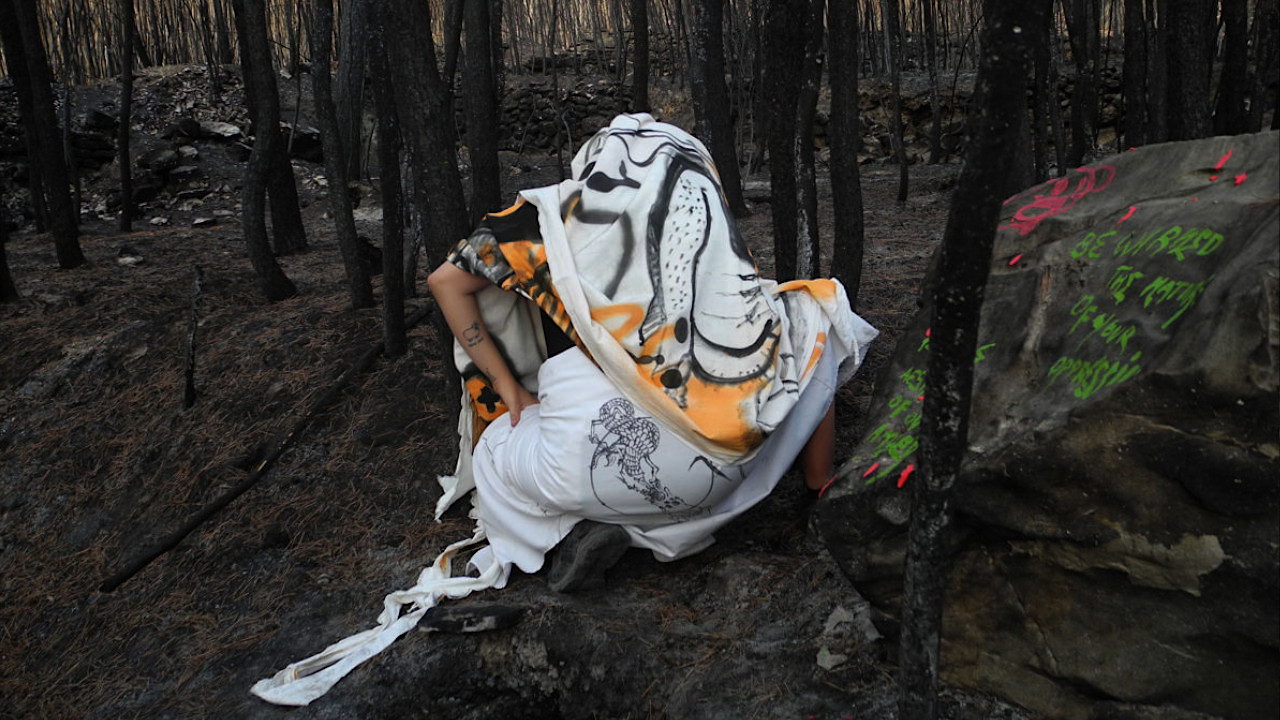
'Kirbytech' by KLNV
The term Crisiscore was born astride its grave, ever mindful of dust. First coined by Wade Wallerstein to describe an emerging terrain of "curatorial practice that traverse physical and virtual spaces, seeking the sublime in precarity and disaster", the moment it was named, it began to immediately unravel into controversy and claims of authority regarding its meaning, practise, territory and historicity. At the end of the day, any naming carries the promise of being taken (and taken apart), and this imperfectly auto-destructing terminology feels, for now, like the perfect designation for a cluster of practices that dwell in a disastrous age and grapple with its intensities across a wide variety of both distinct and intermingling disciplines and methods.
As we struggled to articulate the way in which a project like Solo Show is situated within this newly designated movement, a friend described Solo Show as a town commons
“or forum / center / whatever the communal space was where people used to orate”
This helped us understand Solo Show as a practise of anti-enclosure, carried out within the wastelands in the shadow of eternal time.
Both Cybernetics and Utopia are forms of enclosure. The greatest failure of both is their inability to tolerate internal differences and contradictions; in order to sustain a collective belief-system, Utopia tends toward the strict hierarchization of the values around which it organizes. On the other hand, a Commons is a site for the multiplicity of different methods, styles and values which comprise its participants’ extensive visions and varied habitus. There is no central idol, no single value contained within a quantifiable product, and no predetermined “natural” relationality: it is a continually synthetic process. The lifespan of aesthetics exists, here, within constantly shifting social relations and fractal explorations of the themes which emerge; styles and ideas arise, mutate, submerge, and reappear, changed by each set of hands they pass through.
This also carries beyond purely art-based activity aggregated in specific geographical centers or curatorial agendas, into the local subdivisions of artists and artist-groups navigating work and life around the world. These backstage social relationships which exist beneath the interface and co-develop through its use are the true point of the Commons' existence and are the heart of its ecology. Each of us experiences the strictures of cybernetic hyperreality so differently, depending on where we stand, and likewise the flights of our spirits; specific works and initiatives serve those specific, localized needs and visions, while the paralell and overlapping activity of innumerable localized solutions creates endless co-conspiratorial possibilities. It is such a small step from coming together to pool visions and resources to build an offsite exhibition, to coming together to coordinate all kinds of other actions. From the ground up, Crisiscore is a meshwork of mercurial signal-flares and the dances with which we wave them; from the aerial view, over time, it describes the patterns by which we live, create, connect, and desire in this potent, dazzling and ill~starred age.
Through the images and experiences crafted by artists loosely united by the imperfect descriptor of ‘Crisiscore’, we are finding ways to tell each other about the urgency we feel in the worlds where we stand, what kind of beauty exists there too, and sharing ideas of how we might structure our experiences and live our lives. The “crisis” is not any single historical event, nor is it a speculative provocation; we are all bearing witness to oblivion and finding strategies for moving through it.
One such strategy, the co-cultivation of Eros, is particularly potent within the modality of the offsite exhibition. The offsite is generally a highly specific, embodied experience - constructed in solitude or with just a few friends, occurring in unsorted space - the direct and intrinsic poetry of the work is then connected with such singular visions of others in the shared space of the Commons, moving between continuous and discontinuous worlds. Anyone can enter into this world-building at any time just by scrying, crystallizing and activating the lyricism of our direct environments - all of the endless suburbs and small towns, the backwaters and back-alleys, anonymous apartments in big cities - these are all possible sites where where the combination of intimate, local experiences and high-speed internet combine to create portals into each others’ realities.