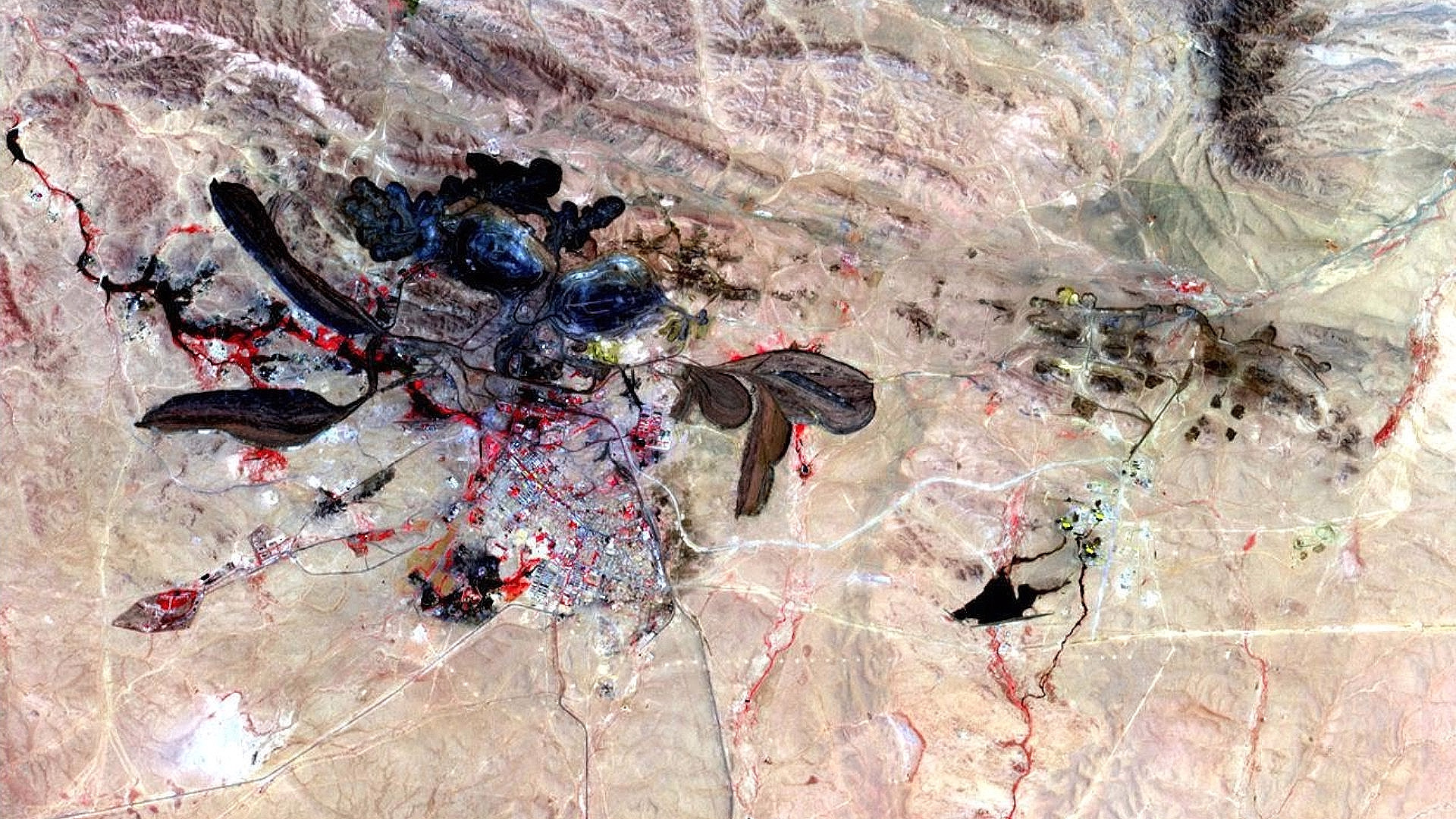
Whenever I talk about Solo Show, I find myself describing it in the language of whatever wave it’s been riding most recently, and it’s truly impossible for me to become the singular voice for a hydra of practices which have meant so many things to so many ppl. I’d like to demonstrate some of these practises by walking through one of our group exhibitions, MAMAN妈妈: an experiment in synthesis which brought decentralized works into proximity as a (not very speculative) climate noir around the site of the Baogang Weikuang Dam in Inner Mongolia. Meanwhile I’ll mention a few ideas (likewise drawn from many sources) that have been formative for me in cultivating these waves upon waves which make me think of the concept of the Hypersea:
In the sea, nutrients pass with relative ease among different organisms. But when life entered land it needed to evolve far more complex relationships to sustain itself. As a result, terrestrial life displays an extraordinary degree of connectedness - to the point where it can be seen as unified, including terrestrial forms. Direct physical connections become essential and so terrestrial organisms have had to build for themselves structures and components in order to perform functions that marine life can take for granted. While moving out of the marine waters, they took the sea beyond the sea, and folded it back inside itself to form the Hypersea: in many ways different from an ocean: for starters, it has no surface on which you can gaze, and it does not seek to be level. If you could look at life on land through a machine that registered only fluid, you would see great columns of nutrient-laced water rising--the columns would be where trees stand. You would see water flowing horizontally underground among plant roots and fungi, pouring into animals as they fed, moving as the creatures moved.” 1
This “machine that registers only fluid” leads me to the continuous existence of Georges Bataille, in which all living beings have, and are connected by, an immanence without clear limit:
“an indistinct flow of being into being – one thinks of the unstable presence of water in water (...) in conflagrations befitting the solar origins of its movement”, a play of energy that breathes life into matter “scarcely distinguished from the immense flux of the world.” 2
In the thought of Bataille, beings are caught in a superabundance of energy which creates biological pressure, challenging them to survive and to seek “elements around {us} which are immanent,” and to establish “relatively stable relations of immanence”3. Existing in the abundant flux, living beings receive energy and accumulate it - “for living matter in general, energy is always in excess”4 - and in turn produce an excess of their own. Continuity “demands expenditure from every living being”. Through pressure and time, ‘taking into account a constant relation of the biomass to the local climatic and geological conditions, life occupies all the available space.”5 Even in the planet’s most inhospitable conditions, the “myriad forms of life adapt with their available resources”.6
The individual is the self that strives to master and work within existence. This existence entailed by work comes, too, with the possibility of a being that wants to overflow; the utility inherent in the desire to be everything meets with the fundamental anguish of existence:
"To ask oneself before another: by what means does he calm within himself thedesire to be everything? Sacrifice, conformity, trickery, poetry, morality,snobbery, heroism, religion, revolt, vanity, money? or by several means together? or all together? A wink of an eye in which glimmers betray the disguised suffering which is the astonishment at not being everything, at even having concise limits, gives us. (...) We are discontinuous beings, individuals who perish in isolation in the midst of an incomprehensible adventure, but we yearn for our lost continuity. We find thestate of affairs that binds us to our random and ephemeral individuality hard tobear. Along with our tormenting desire that this evanescent thing should last,there stands our obsession with a primal continuity linking us with everything that is."7
The isolated existence of all beings ~ individuated by work, by temporality and utility, etc ~ is felt as discontinuity; and continuity is that state brought about by transgressing the barriers of separation, fusing us into a phenomenological unity; more elemental than existentential. The very possibility of the erotic experience comes from this twofold existence; it is a phenomenon that is predicated on discontinuous beings, yet beings experiencing it are extended beyond the boundaries of the individual.
As such, Eros resists enclosure and is inherently disjunctive to trajectories of continual progress. It is the affect which ascends “{When} a system can no longer grow, or if the excess cannot be completely absorbed in its growth … {it} must necessarily be spent without profit; it must be spent, willingly or not, gloriously or catastrophically”8 - such energy must be squandered. This excess begins where the gears of productivity grind to a halt, where linear progress fails to govern: ‘The impossibility of continuing growth makes way for squander...{it begins when} growth has reached its limits.’ 9
The place where we begin our activity is at this impossibility of further growth - of the individual artist, of the extractive industries, of the petrosentient miasmas and cybernetic totalities - a trajectory determined long ago in the procession toward the technocratic age where further growth, both temporal and conceptual, is demarcated by endless signifying chains of the post-(whatever came before): where motion is semantically designated by indicating saturation upon saturation and hydroplanes on the mirrored glass of Empire.
This squandering is both a metabolic process that exists wherever power is generated and operates upon both use and surplus values as designated within a fully accellerated, end-civilization terrain. We are, after all, no longer housed within systems of value presided upon by priest and king and grounded in social repression or proto-communal taboo, but in a space of infinitely permissive, partial subsumption where the spectral double of the thing is almost indistinguishable from the moment of its emergence, and maximum individualistic effort is encouraged by a formless, slippery, and comprehensive daemon encoded in the subscript of our affects, memories and dreams. All recognizable subject-positions can be challenged forth as data and to rethink the project of dialectics in the contemporary cybernetic theatre of the double is to question how we might bear witness to non-identity. If all attempts to assert authenticity collapse into consumer differentiation - all grist for the mill, every gesture absorbed in advance - might we squander our end-civilization birthright of dialectical individuation to disable that engine entirely, if only for an endless cascade of moments? And so we begin from a posture which arches its poly-vertebral spine far beyond the boundaries of the atomized-and-sutured system.
We find that both Eros and Crisis, each by their own motions, serve as continual interruptions within all forms of enclosure, and the very conditions of enclosure likewise necessitate our motion toward all forms of communion, just as ”if human beings had kept their own integrity and hadn’t sinned, God on one hand and human beings on the other would have persevered forever in their respective isolation”9. This “divine love which is guaranteed by crime”10 is the driving force of any encounter and underscores our mutual striving.
Likewise, it is impossible to conceive of an ‘end’ to alienation or an un-alienated space which we must attain before the real work starts – rather, within the necessarily alien terrain of schism and discontinuity, we begin the lucidity rituals of networked existence.
Adorno, in his 1949 Minima Moralia, describes fungible alienation as a condition wherein industrial and ideological coordinates are sufficient to produce endless, interchangeable, self-contained expressive options within alienation. In today's world of cybernetic hydroplane, we cannot point to any distinct register of alienation, "non-alienation" is not a meaningful figure, the symptom has become holistic. Might we imagine a form of alienation that sidesteps the dialectical production of authenticity in its entirety? What if we don't need to reclaim a "lost" authenticity, and if we instead begin from the inherent mythmaking of any communal project -- by entering the eros of alienation itself as a lyrical and insurgent tactic, maybe we can extricate ourselves (even for a moment) from this engine which thrives upon doubling our ownmost and forces us to watch, from the sidelines, its doubling and reification.
Here I remember the words of Sadie Plant (quoted by A.M. and excerpted in context), who also circumambulates a pre-boundaried space where entities and flows interlace and entangle:
“an endless geographic plane of micromeshing pulsing quanta, limitless webs of interacting blendings, leakings, mergings, weaving through ourselves, running rings around each other, heedless, needless, aimless, careless, thoughtless, amok. […] Free exchanges, microprocesses finely tuned, polymorphous transfers without regard for borders and boundaries.
And then something occurred to us. The climate changed. We couldn't breathe. It grew terribly cold. Far too cold for us. Everything we touched was poisonous. Noxious seas and thin toxic airs flooded our oceanic zone. Some said we had brought it on ourselves, that all our activity had backfired, that we had destroyed our environment by an accident we had provoked. We mutated to such an extent that we were unrecognizable to ourselves, banding together in units, working as slave components of systems whose scales and complexities we could not comprehend.”1
Early systems of kinship emerged when “our aphotic ancestors migrated and mutated to live upon this toxic environment, becoming organized according to cyclical structures” (which humans came to call Time, and organized their productive and reproductive activities according to its repetitions). This “cyclical time, arising from changing seasonal occupations” allowed for the sedimentation of social codes. Within this “primitive territorial machine,” kinship delimited the circulation of value, allowing its movement through filiation and alliance. “Such organizations [of alliance] reproduce themselves culturally through shared myths articulated around basic dualities (day/night, sun/moon, etc.). The function of these myths is to enclose alterity within a system of rules, to provide it with an identity, and to exclude the possibility of the radically different.”
The “barbarian despotic machine” of the State was born when such “filiation was generalized as a link between subject and ruler”9, in turn inventing both metaphysics, dynasty and labor, “simultaneously unifying territorial alliances into the conceptual filial line of a single, despotic father or God, while artificially engineering inhibition of synthesis through constraints on commodification whenever this threatened to dissolve social codes.”10 Industrialization, which {…} “autonomized value circulation beyond the state-centered coding of the barbarian despotic machine”11, corresponds to the initiation of the linear time of urban, industrial organization: the “civilized capitalist machine,” {the precursor of} technocapital.
But “The move to dry land is not an irreversible process. Deep amongst the body's tides, amphibian tendencies draw an organism to the hydral state from which it once emerged. (...) The body carries within itself far more than its current evolutionary stage. Man's progress has told the story straight. Starting at zero: bacteria, algae, fish, amphibian, reptile, bird, mammal."
"{The zero} of the Deep Ones, is the “positive zero – or 'the matrix' –[which] individuates a secondary, re-productive process that represses the conditions of its emergence in order to enter into the world of representation and recognition. (...) Like concrete, this zero camouflages its liquidity, hides that it “dissolves binaries, dis-associates, mutates existing structures, and generates the completely new. The emancipation of material forces corresponds to the emancipation of zero as the irruption of the utterly novel – first disguised as
something else."
In closing, I transcribe the lyric of Night Science: Vision After the Sermon, created by Most Dismal Swamp for MAMAN妈妈:
"If all the matter in the world
Except our fictions
Were swept away,
Our world would still be recognizable."
If, as angels,
We could then investiate this debossed trash stratum
We should find a horizonless swxmp
Represented by a viscid film of uneven and combined heresy,
A long tail of ideological mixta.
(...)
[[Fuck it, dissasociationcore]]
[[Globally variable synaesthesia intensifies]]
[NEXT] ❥